
Regenerative medicine has increasingly turned its attention toward a rare, naturally occurring stem cell population known as Muse cells – and, more recently, toward the tiny vesicles these cells release. MUSE cell exosomes are extracellular vesicles secreted by Multilineage-differentiating Stress Enduring (Muse) cells, carrying proteins, lipids, and genetic material that may help coordinate the body’s own repair processes. Unlike the stem cells themselves, exosomes are not living cells – they are cargo-carrying packages that cells use to communicate with one another.
Interest in this area has grown alongside a broader shift in regenerative medicine toward “cell-free” approaches, where the signaling molecules secreted by stem cells are studied separately from the cells that produce them. This article explains what Muse cells are, how their exosomes differ from the parent cells, what current research suggests about their potential mechanisms, and what the evidence realistically shows at this early stage of investigation.
What Are MUSE Cells?
Muse cells were first identified in 2010 by Dr. Mari Dezawa and colleagues at Tohoku University, who discovered a rare subpopulation of cells within ordinary mesenchymal stem cell (MSC) preparations that could survive harsh enzymatic and stress conditions and spontaneously express pluripotency-associated markers such as Oct3/4, Sox2, and Nanog (Kuroda et al., Proc Natl Acad Sci USA, 2010). These cells were named for their defining traits: they are Multilineage-differentiating, Stress-Enduring cells, and they are marked by the surface antigen SSEA-3.
What sets Muse cells apart from typical MSCs and other adult stem cell types is a combination of features. They occur naturally in bone marrow, adipose tissue, dermis, and peripheral blood, without requiring genetic reprogramming. Research indicates they display low telomerase activity, a trait associated with a favorable safety profile and reduced tumorigenic risk compared with induced pluripotent stem cells, while still retaining the capacity to differentiate into cells representing all three germ layers (Que et al., Front Cell Dev Biol, 2024). Muse cells also appear to home preferentially to sites of tissue damage after intravenous administration, a property that has driven much of the clinical interest in Muse-based approaches (Dezawa, Biogerontology, 2025).
What Are MUSE Cell Exosomes?
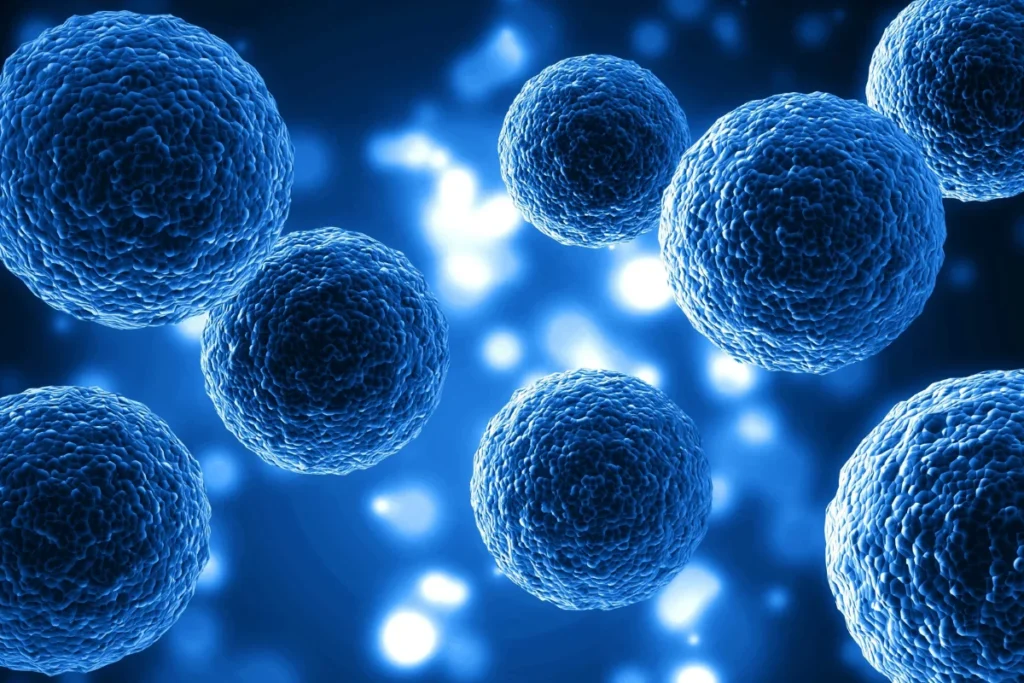
Exosomes are small extracellular vesicles, typically 30 to 150 nanometers in diameter, that cells secrete as a means of intercellular communication. They are not stem cells and do not replicate; rather, they are membrane-bound packages containing proteins, lipids, microRNAs, and other signaling molecules reflective of the cell that produced them. MUSE cell exosomes, specifically, are the vesicles released by Muse cells, and researchers have proposed that they may retain a meaningful share of their parent cells’ regenerative and immunomodulatory signaling properties (Rajabi & Bonyadi, Stem Cell Rev Rep, 2025).
This distinction matters clinically. Cell-based Muse therapy involves administering living cells that may engraft, differentiate, or persist at an injury site. An exosome-based approach, by contrast, is being explored as a “cell-free” alternative – delivering only the secreted signaling cargo rather than the cells themselves. Researchers have hypothesized that this could simplify manufacturing, storage, and delivery compared with live-cell therapies, though this remains a proposed framework rather than an established clinical pathway (Rajabi & Bonyadi, Stem Cell Rev Rep, 2025). For a broader look at how cell-based and cell-free regenerative approaches compare, see our discussion of stem cells versus exosomes for regenerative therapy.
Potential Benefits and Mechanisms
Much of the interest surrounding Muse cells and their exosomes centers on paracrine signaling – the idea that these cells exert their effects less through direct tissue replacement and more through the molecules they release into the surrounding environment. Muse cells have been observed to secrete protective factors, including serpins and 14-3-3 proteins, that may help cells survive hostile, low-oxygen, or inflamed microenvironments and may reduce programmed cell death in damaged tissue (Que et al., Front Cell Dev Biol, 2024).
Immunomodulation is another area of focus. Muse cells reportedly express elevated levels of HLA-G and produce indoleamine 2,3-dioxygenase (IDO), mechanisms associated with immune tolerance that may allow allogeneic (donor-derived) Muse cell products to be used without HLA matching or immunosuppressive medication in some research settings (Que et al., Front Cell Dev Biol, 2024). Because exosomes are thought to carry a subset of these same regulatory signals, researchers have proposed that these exosomes may contribute to anti-inflammatory and immune-balancing effects as well, adding to the broader set of proposed regenerative effects under active investigation, including anti-apoptotic, anti-fibrotic, and tissue-repair-supportive activity (Rajabi & Bonyadi, Stem Cell Rev Rep, 2025). It’s worth emphasizing that these mechanisms are described as associative and evidence-emerging rather than definitively proven in humans.
The Evidence: What Research Shows
The clinical evidence base for Muse cell science has grown steadily since the cells were first described, though it remains an early-stage field overall, and evidence specific to isolated exosomes lags further behind evidence for the cells themselves. The foundational 2010 discovery paper established Muse cells as a distinct, naturally occurring pluripotent-like population within adult tissue (Kuroda et al., Proc Natl Acad Sci USA, 2010), and subsequent preclinical work has extended this into models of tissue injury, where Muse cells have been associated with reduced inflammation and apoptosis and improved tissue-level outcomes (Que et al., Front Cell Dev Biol, 2024).
On the clinical side, a randomized, placebo-controlled Phase 2 trial of CL2020, an allogeneic Muse cell–based product, evaluated intravenous administration in patients with subacute ischemic stroke. The trial reported a numerically higher rate of functional response in the Muse cell group compared with placebo, without evidence of serious treatment-related adverse events, though the authors noted the study was not powered to demonstrate definitive efficacy and called for larger confirmatory trials (Niizuma et al., J Cereb Blood Flow Metab, 2023). This trial evaluated the Muse cell product itself rather than isolated exosomes, which illustrates an important gap: dedicated human trials of these exosomes specifically remain limited, and much of the current exosome-focused literature is conceptual or preclinical, proposing a research framework for future study rather than reporting completed clinical outcomes (Rajabi & Bonyadi, Stem Cell Rev Rep, 2025). Comparative analysis between Muse cells and conventional MSCs further suggests Muse cells may offer certain biological advantages relevant to long-term tissue health, though this too is described as an area requiring further validation rather than an established conclusion (Dezawa, Biogerontology, 2025).
Taken together, the research indicates a genuinely promising but still-developing field. Evidence suggests Muse cell biology has real translational potential, and early clinical data for Muse cell–based products is encouraging, but claims specific to Muse-derived exosomes as a standalone therapy remain hypothesis-driven and warrant cautious interpretation.
Safety Considerations and Current Status
MUSE cell exosome applications, along with Muse-based stem cell treatment more broadly, are not FDA-approved therapies in the United States. Muse cell–based products have been studied in clinical trials, primarily in Japan, under regulatory pathways specific to those programs, and exosome-based applications remain even earlier in their research trajectory. No regenerative therapy in this category should be assumed to be a proven treatment for any specific condition.
Anyone considering Muse cell science, whether in the context of general interest or a specific health concern, should understand this is an emerging area of research rather than a routine clinical option. Individuals should discuss any regenerative therapy, including those explored for skin, hair, or musculoskeletal support such as those covered in our review of exosome therapy for hair loss, with a qualified healthcare provider who can evaluate individual health history, current evidence, and realistic expectations before proceeding with any regenerative approach.
Frequently Asked Questions
What are MUSE cell exosomes?
They are small extracellular vesicles secreted by Muse (Multilineage-differentiating Stress Enduring) cells, carrying proteins, lipids, and RNA that may reflect some of the signaling activity of their parent cells, though they are not living cells themselves.
How are MUSE cell exosomes different from the Muse cells that produce them?
Muse cells are living, pluripotent-like stem cells capable of differentiating into multiple tissue types. Their exosomes are cell-free vesicles that carry signaling cargo but cannot replicate, engraft, or differentiate – they function purely as communication packages between cells.
What are the potential benefits of Muse cell therapy?
Research into the potential benefits of Muse cell therapy points to paracrine signaling, anti-inflammatory and immunomodulatory activity, and support for tissue repair processes following injury. Evidence for these effects comes largely from preclinical models and early-phase clinical trials, so findings should be considered emerging rather than conclusive.
Is MUSE stem cell treatment FDA-approved?
No. MUSE stem cell treatment and MUSE cell exosome applications are not FDA-approved in the United States. They remain part of an active, evolving area of regenerative medicine research, with most controlled clinical trials conducted internationally.
What conditions have been studied with Muse cell–based products?
Clinical research has explored Muse cell–based products in conditions such as subacute ischemic stroke, with early-phase trials evaluating safety and functional outcomes. Investigation into other applications is ongoing, but published human trial data remains limited overall.
Are MUSE cell exosomes the same as MSC-derived exosomes?
They are related but distinct. Both are extracellular vesicles secreted by stem-cell populations, but Muse cells are a specific pluripotent-like subset that can be found within broader MSC preparations, and researchers have proposed that Muse-derived exosomes may carry a distinct signaling profile compared with exosomes from unselected MSC populations.
Is Muse cell exosome research safe?
Published Muse cell trials have generally reported favorable safety profiles without serious treatment-related adverse events, though research specific to isolated exosome products is less mature. Anyone considering this area should consult a qualified provider and rely on current, evidence-based information rather than unverified claims.
How can I learn more about Muse cell science?
Individuals interested in Muse cell biology and its potential applications should review current peer-reviewed research and speak with a qualified regenerative medicine provider who can explain what is and is not currently supported by clinical evidence.
Key Takeaways
- MUSE cell exosomes are extracellular vesicles secreted by Muse (Multilineage-differentiating Stress Enduring) cells, not the stem cells themselves
- Muse cells were discovered in 2010 as a rare, naturally occurring pluripotent-like population within adult mesenchymal tissue
- Proposed mechanisms behind the potential benefits of Muse cell therapy include paracrine signaling, immunomodulation, and support for tissue repair
- Exosome-based “cell-free” approaches are being explored as a potential alternative to live-cell administration, though research remains early
- A randomized Phase 2 trial of a Muse cell–based product in ischemic stroke reported favorable safety and encouraging, though not definitive, functional outcomes
- Dedicated clinical evidence for these exosomes specifically is more limited than evidence for Muse cells as whole-cell products
- MUSE stem cell treatment and related exosome applications are not FDA-approved and remain an emerging area of research
- Anyone exploring this field should consult a qualified healthcare provider for personalized guidance
To learn more about the science behind Dezawa MuseCells® research, visit our Muse cell overview, or schedule a consultation with our team to discuss whether regenerative options may be appropriate for your health goals.
References
- Kuroda Y, Kitada M, Wakao S, et al. “Unique multipotent cells in adult human mesenchymal cell populations.” Proc Natl Acad Sci USA. 2010;107(19):8639–8643. DOI: https://doi.org/10.1073/pnas.0911647107
- Que H, Mai E, Hu Y, Li H, Zheng W, Jiang Y, Han F, Li X, Gong P, Gu J. “Multilineage-differentiating stress-enduring cells: a powerful tool for tissue damage repair.” Front Cell Dev Biol. 2024;12:1380785. DOI: https://doi.org/10.3389/fcell.2024.1380785
- Rajabi A, Bonyadi M. “Muse Cell-Derived Exosomes: a Hypothesis for a Cell-Free Therapeutic Platform in Regenerative Medicine.” Stem Cell Rev Rep. 2025;21(6):1860–1862. DOI: https://doi.org/10.1007/s12015-025-10916-6
- Niizuma K, Osawa SI, Endo H, Izumi SI, Ataka K, Hirakawa A, Iwano M, Tominaga T. “Randomized placebo-controlled trial of CL2020, an allogenic muse cell-based product, in subacute ischemic stroke.” J Cereb Blood Flow Metab. 2023;43(12):2029–2039. DOI: https://doi.org/10.1177/0271678×231202594
- Dezawa M. “Comparison of MSCs and Muse cells: the possible use for healthspan optimization.” Biogerontology. 2025;26(4):139. DOI: https://doi.org/10.1007/s10522-025-10275-2
Author: Ways2Well Editorial Team
Reviewed by: Scientific Advisory Board member